Wednesday, September 13, 2023

Mary (Perkins) Bradbury, and the Salem Witch Trials

Recently my niece was asking about the Bradbury family and if she was related to her friend whose surname was Bradbury.  I asked if he knew the story of Mary Bradbury who was accused of being a witch during the Salem witch trials.  He was aware that she was his ancestor.   My niece isn't always fond to hear that her parents, grandparents share ancestors and in this case, both of her parents are descendants of Mary Bradbury.

Mary Perkins was baptized on September 3, 1615 at Hillmorton, Warwickshire, England, the daughter of John and Judith (Gator) Perkins.  This is the same church her parents were married in 1608.


Mary's father for whatever reason from lack of property, or to join the puritans in the new world, set sail with family on the ship "Lyon" on October 9, 1830 from Bristol, England and arrived in Boston, Massachusetts on February  5, 1631.  The ship which contained some much needed supplies for colonly also had 20 passengers.  Of twenty passengers, there was John, age 48 and his wife, Judith, and at least 5 of their children including Mary. 

                                            replica of the ship "Lyon"

Mary's family settled in Ipswich, Massachusetts by 1633 and she married Thomas Bradbury of Salisbury, Massachusetts in 1636, who was the land agent for his great-uncle, Sir Fernando Gorges, the colonial proprietor of the State of Maine and backer of the failed colony at Popham in Phippsburg, Maine.  Thomas was considered one town's more distinquished citizens and one of it's earliest settlers.   Thomas and Mary had eleven children together.  

Through the years there had been some disagreements with another early family, the Carr family.  Some of the complaints against Mary were nearly 20 years old or older.  One story was that George Carr had asked for Mary's hand in marriage which she declined in favor of Thomas Bradbury and that had begun a long standing family fued.  As most of Mary's accusers of witchcarft were the Carr family member, namely Ann (Carr) Putnam and their friends, the Endicotts.

On May 26, 1692, Mary Bradbury, who was in her mid 70s, was accused of tormenting Mary Marshall of Reading, and Mary Walcott, Mercy Lewis and Ann Putnam Jr of Salem.  On June 23, 1692, Timothy Swan of Andover fell sick and claimed it was from being attcked by witches who flew into his father's house in Haverhill, Massachusetts and Mary's specter was specifically named as his attacker.  Mary Bradbury was arrested on June 28th and taken to the Salem jail.


Trabscription

Essex in the province of the Massachusetts Bay in New EnglandAnno R R's & Reginae Gulielmi & Mariae Angliae &c Quarto Annoq'e Domini 1692/Ss/ The Juriors for our Sov'r Lord and Lady the King and Queen doe present That Mary Bradbury Wife of Capt Thomas Bradbury of Salisbury -- In the County of Essex Gent upon the Twenty=Sixth day of July

In the yeare aforesaid and divers other dayes and times as well before as after Certaine Detestable arts called Witchcraft & Sorceries Wickedly Mallitiously and felloniously hath used practiced and Ex- ercised At and in the Township of Andivor in the County of Essex aforesaid in upon & against one Timothy Swann of Andivor In the County [#aforesaid] Aforesaid Husbandman -- by which said Wicked Acts the said Timothy Swann upon the 26th day of July Aforesaid and divers other days & times both before and after was and is Tortured Afflic- ted Consumed Pined Wasted and Tormented, and also for Sundry other Acts of Witchcraft by the said Mary Bardbury Comitted and done before and since that time against the peace of our Sov'r Lord & Lady the King and Queen theire Crowne and dignity And the forme Of the Statute In that case made and Provided.
Wittness
Mary Walcott
Ann: Puttnam

( Essex County Court Archives, Salem - Witchcraft vol. 2, no. 69. Massachusetts Supreme Judicial Court, Judicial Archives, Massachusetts State Archives, Boston, MA)

Mary tried to defend herslef in response to the accusations of witchcraft

Transcription:

The Answer of Mary Bradbury in the charge of Witchcraft or familliarity with the Divell I doe plead not guilty.

I am wholly inocent of any such wickedness through the goodness of god that have kept mee hitherto) I am the servant of Jesus Christ & Have given my self up to him as my only lord & saviour: and to the dilligent attendance upon him in all his holy ordinances, in utter contempt & defiance of the divell, and all his works as horid & detestible; and accordingly have endevo'red to frame my life; & conversation according to the rules of his holy word, & in that faith & practise resolve by the help and assistance of god to contineu to my lifes end: for the truth of what I say as to matter of practiss I humbly refer my self, #[my selfe,] to my brethren & neighbors that know mee and unto the searcher of all hearts for the truth & uprightness of my heart therein: (human frailties, & unavoydable infirmities excepted) of which i bitterly complayne every day:/
Mary Bradbury

( Essex County Court Archives, Salem - Witchcraft vol. 2, no. 72, Massachusetts Supreme Judicial Court, Judicial Archives, Massachusetts Supreme Judicial Court, Judicial Archives, Massachusetts State Archives, Boston, MA )

At the same time 115 residents of Salisbury signed a petition stating her good character and reputation and long standing love of the gospel.  Her husband also testified on her behalf.  At her trail on July 2nd, her accusers were namely the Carr family, the sons of George Carr: Richard, James and their sister Ann (Carr) Putnam.  Her husband, Thomas Putnam recorded all the depositions in his own handwriting.  Mary was accused of everything from making butter turn rancid, causing sickness, tormententing Ann Putnam, to causing the death of her former suitor, George Carr and his son, John Carr, who had been in love her daughter, Jane Bradbury and was  spurned by her love and marriage to Henry True.  Only William Carr gave testimony in favor of Mary's innocence.

                                            Engraving of the witch trials

On September 10, 1692, Mary Bradbury and 5 other women were convicted of being wicthes and sentenced to hang.  On September 22, 1692, four of the women were hung at gallow's hill (now a park).  One woman confessed the night before and was granted another month to her things in order and by then the hangings were over.

                                            Gallows Hill now a park where people were hung

Mary Bradbury with the help of her husband managed to escape the hangman's rope.  With help from her friends and her husband's connection with the Phipps' family, she escaped from jail, but was forced to live as a fugitive for another year possibly in Maine.  She returned to her family in May 1693.

Mary lived several more years dying on December 20, 1700 in Salisbury, Massachusetts and likly buried with her husband in the old Burying ground with their stones lost to time.

In September 1710, Mary's daughter Jane and her husband Henry True petitioned the court for a reversal of the conviction of Mary and restitution. On October 17, 1711, "An Act to Reverse the attainders of George Burroughs et al. for witchcraft was passed.  Mary's name was cleared the family received 20 pounds.

Mary's descendants include many Presidents, authors, actors and actresses, all of whom can be found on the website Famous Kin.

Our family line is

                                            1. Mary (Perkins) Bradbury
                                            2.Jane Bradbury m. Henry True
3. William True                                                                    3. Jabez True
4. Samuel True                                                                     4. Jabez True
5. Dudley True                                                                     5. Sarah (True) Stinchfield
6. David True                                                                       6. Sarah (Stinchfield) Hicks
7.Samuel Trew                                                                     7. Sarah (Hicks) Southard
8. Isabel (Trew) Akerley                                                      8. William Southard
9. Charlotte (Akerley) Corcoran                                          9. Omar Southard
10. Bruce Cororan                                                               10. Edna (Southard) Skinner
11. Carolyn (Cororan) McMann                                         11. Ethelyn (Skinner) Smith
12. Colleen (McMann) Smith                                             12. Glenn Smith
                                                                                            13. Michael Smith


Monday, July 17, 2023

When a Father is a Father and not the Father

Many of you know that in 2017, we had found my mother was a half-sister to her sibling and her biological father was a neighbor to her parents in Charleston, Maine.  It was during our meeting with her half sister, Carol and her daughters that I learned Carol's husband was the son of a Berdina Skinner.  My grandmother was Ethelyn Skinner of Exeter, Maine.  They told me that an uncle had traced their Skinner line back to a John Skinner of Lewiston, Maine which made me realize that I had another connection to these cousins as I am also a descendant of the same John Skinner.  Tracing our lines, we found our grandmothers were 2nd cousins.

I began to trace some of the other lines of descent from John Skinner as well.  I came across two of his grandchildren had married each other (Yes they were 1st cousins).  My interest was drawn to the Civil War pension of George Skinner of Weld, Maine on behalf of his son, John Francis Skinner's military service.  It was interesting that his pension request was denied twice. So I requested copies of the pension from the National Archives.  Upon receiving the pension records I discovered a tragic story of a pension being denied because George was not John's biological father.  Despite testimony from friends and neighbors that George had always been known as John's father and no one knew anything different.  Also John had helped George by sending money to help him before his death in the war.  By the late 1870s, George Skinner was in poor health and in need of financial support.  He petitioned twice because a commission asked the case be re-opened on the grounds that if John had supported George before his death as his known father, then it should be considered.


Here is what is known about the family:

George Skinner was born 27 March 1812 in Danville [now Auburn], Maine, the son of Andrew and Wealthy (Green) Skinner, grandson of John and Catherine (Jordan) Skinner.  He married Susan M. Skinner on 18 May 1833 in Topsham, Maine.  Susan was born about 1811 in Topsham, Maine, daughter of David and Lucy (Graves) Skinner, granddaughter of John and Catherine (Jordan) Skinner.  The Vital Records of Topsham, Maine show two marriage intentions for Susan.


Her parents marriage intentions are recorded as well.  Susan and a John Latchford of Bath, Maine intentions in 1830, but no record of marriage.  Then the intentions between Susan and George Skinner in 1833.  The pension of George Skinner contained the marriage date for him and Susan of 18 May 1833 in Topsham, Maine.  A John Luchford was living in Bath, Maine on the 1830 census, but does not appear again or in any other records in Bath or Topsham, Maine.

Susan gave birth to John Francis Skinner in 1831 in Topsham, Maine, but no record of his birth has been found in records and births of single mothers were rarily recorded nor is there any court records showing that Susan or her family petitioned for any legal consequences for John Latchford being the father of her child.  However, Susan married her cousin George Skinner and they removed to Carthage, Maine as well as Susan's parents.  

In 1850, Susan Skinner was living in the household of her parents with her son, John Skinner, but George was not recorded with them, but appears living in Harpswell, Maine working and living alone as it appears he had to find work that year away from his family to support them.

Susan Skinner died 15 April 1857 in Carthage, Maine was buried with her parents there.  George remarried on 27 November 1858 in Weld, Maine.  He was living with Harriet on the 1860 census of Carthage, Maine and from testimony from George's neighbors, John Skinner had moved to Massachusetts to find work at this time.

John Francis Skinner enlisted on 2 April 1864 as a private in Company E, 32nd Maine Infantry regiment of volunteers. This regiment was involved in many major battles of that year from the Battle of the Wilderness, Spotsyvania, and seige of Petersburg to name a few.  The regiment took aprt of the Battle of the Crater as it was known.  Union troops besieging Petersburg, Virginia used a mine to blow a hole in the Confederate defenses. However the troops could not advance further and many were slaughtered at the bottom of the "Crater" in what one officer later described as a "turkey shoot". Rather than retreat, General Burnside sent in a division of the U. S. Colored Troops who were also trapped. Many were killed even after surrendering. As a result of this debacle, Burnside never commanded troops again. 

John was captured on 30 July 1864 and taken to the Danville Prisons, Virginia.


Here is where John Skinner died on 25 August 1864 from disease.  

 George Skinner appears on the 1870 and 1880 census records of Weld, Maine residing with another people in the area.  George appied for a pension on behalf of his son' service 15 October 1875.  Tesitmony was collected from neighbors to his poor health and poor circimstances of himself anf his wife.  However a letter received from the pastmaster of Topsham contained a letter written to Daviod Skinner, dated 20 January 1846 from White Oak Bottom, Maryland in regards to being the father of John Skinner.  This letter write to David Skinner, being Susan's father.  This resulted in his pension being rejected on the grounds the claimant was not the legitmate father of John Skinner.  This must have been a disappointment to George who stated he ahd always considerred John his natural son.

A commission in 1887 sent the pension back for consideration to deteremine if it could be proven that before John's death, his father George was dependent on money from him, and what money George had earned before John F. Skinner joined the war.  Letters were written again of George's poor health from rheumatism and other health issues limiting his ability to work and that he had no property. It was implied that it was a lie that George was not the father of John Skinner as the number of neighbors who knew George knew nothing different as to George not being John's natural father. 

George' pension request was again rejected on the grounds that George had been able to work before his son went to War and had been earning some money.  Although John Skinner had contributed money to the family, John was not the sole contributor to the family's income therefore it did not negate the orginal rejection.  Nothing else appears to have come his pension application afterwards.  No record of George's death or burial has been found.  Being a pauper at the time of his death, no gravestone would have paid for him by town and with no other close relatives to pay for his final expenses, nothing more is learned of George Skinner.   

George Skinner was a father to John Skinner, but not the biological father of John Skinner and in the eyes of the government pension office, this meant that George was not the father of John, even if John Skinner knew no other father.

Thursday, July 6, 2023

Aunt Leona and how I became interested in Genealogy.

                                                    My Great-Aunt, Leona (Smith) Judkins

When I was fourteen years old, an uncle of mine had passed away and I went with my parents to attend the funeral. My Dad and I had dropped my mother off at her sister's house in Pittsfield.  My Dad wanted to take a drive out to Corinna where had lived until 1972 to go to his parent's graves.  Although I had been there before as my Dad always made the trip to the cemeteries for Memorial Day and put flowers of his parent's graves.  Until this trip, I had never really had much interest in my family history outside knowing my parents, aunts and uncles and cousins.  I had been close to my grandmother Smith as a child as she often took care of me for periods of time when brothers were born or sick, etc loved her and spending time at her house.  

One of the big excitements for me when at I was at my grandmother's house was calling my Aunt Leona.  Now my Aunt Leona was late grandfather's Smith sister.  I was not aware of exactly how she related to me as child, I just called her aunt Leona and I was able to talk on my grandmother's phone a real person! I was never allowed to talk on the phone at home, unless it was to say I love you or goodbye to a family member.  It was one old big black phones with a rotary dial.


I felt so grown up to talk on the phone.  I know look back at those days and realize my grandmother was trying to keep occupied while she trying to prepare meals for wither lunch or dinner or some choir without me under foot. Aunt Leona told me years later, she remembered my phone calls very well and although she didn't always understand what I as saying or talking, I sounded so excited, she would just listen to me talk. Of course, I was probably only about 5 or 6 years old when I began talking to her and she was in her 70s, a widow with a grown grandchild, so she found a nice distraction. In 1972, my family left Corinna and my grandmother died that same year and contact with Aunt Leona ended.


My Dad and I made the trip the Corinna Village cemetery and we got out and of course, I recognized the graves with my grandparent's names.But =


There other stones in the same lot and I asked who are these other people?


My Dad explained that there were my great-grandparents Smith, parents of grandfather and behind us were the graves of Joseph and Arminda Smith, my grandfather's grandparents.  I was amazed that I was looking at three generations of my family, going back in time to a man born in 1835.My Dad only remembered his grandfather, J. Clifford Smith as a child, but didn't know anything about him. So My Dad says, I know someone who can tell you all about them, your aunt Leona.  So we were off! Aunt Leona only lived a mile away.

In 1978, Leona was 82 and walked very slow and had to use a walker to get around.  When Leona answered the door and asked her if she knew who he was?  She immediately answered "Malcolm?"
who was my uncle and my Dad said No it's me Glenn.  Leona gave him a hug and then I was introduced, and we were invited into her home.  Dad explained to her we had been in the cemetery and I had questions about the Smith in the cemetery and could not answer them.

It was over the next few hours we sat in her livingroom that Leona told me the story of her grandfather, Joseph Smith sailing to California during the Gold Rush, striking gold and making a small fortune.  She only knew he had sailed from Belfast, Maine around the Horn of South America and up the west coast of the Americas to San Francisco.  She said he remained there for several years and returned home to Corinna because while he was gone, all of his siblings died and his parents needed his help with the family farm.  She had known her great-grandfather, Daniel Jones Smith, who was my 3rd great-grandfather as he lived with her grandfather.  I remember being amazed that this woman I am related to and is telling me about an ancestor who was born in 1810.  Daniel had married for his 2nd wife, Fannie Ireland who was the first white baby girl born in Corinna.  Leona then told me to a table and there were photos of my ancestors, Joseph and his wife and his parents.  It was amazing that I could see what these people looked like.  I had never thought about who my ancestors were and what they had done that actually was apart of history I was learning about in school.


                                        Joseph Smith                                                            Daniel Jones Smith

As much as I would luke to rely on my aunt's stories being 100% accurate, one part of the family story didn't hold up as well when it came to factual research.  Joseph's wife, Arminda Devereaux.


According to Leona, Joseph had met his wife in California where she was working as a barmaid.  She claimed that Arminda's father was one of four brothers who were sea captains and had sailed from France to Maine.  Leona remembered her grandmother as being kind and raising her siblings and herself after their mother had died.  She was religious and strict, but loved her dearly.

This part of the ancestral story did not match the facts that the Devereaux family could be traced back to the early 1600s arriving in Massachusetts from England.  There was no evidence that Arminda ever lived in California, however 3 of her sisters did live there later in their lives.  None of them as far as I can find were ever barmaids.  

My talk to with my aunt did yield some controversy.   When I asked Leona on more details on her grandfather's time in California, she knew very little and she said he rarely spoke about it.  She would hear bits and pieces about, but didn't remember what was said.  She said that a cousin would visit her family periodically and she remembered would tell them stories about those "crazy Devereauxs" but again didn't remember any of them.   However, Leona mentioned that her grandfather had a gold watch and chain made from the gold he mined and it been left to her father who left it to her brother, my own grandfather.  She said my aunt had it, but it was supposed to be passed to a male in the family.  She was going to ask my aunt what had happened to it.

So we left my aunt's house with my mind filled with stories she had shared and couldn't wait to share.  We stopped at my aunt's house on our way to get my mother and I said to my aunt "did you know we were French?" to which my aunt responded "That blood has all petered out by now."  I knew that being of  French ancestry was not a fact that my aunt wanted to be known for.  My Dad brought up that watch &  chain and asked if she knew what happened to it.  My aunt said she had it and it was part of the estate from their father, but all she had was a watch chain and no watch came with it.  She brought it out from a safe she kept stuff in and I got to hold and feel how heavy it was.  It was amazing I was holding something made in 1862 and had been in the family for 4 generations.  My aunt put it away and we left to get my mother.

                                                    Aunt Leona and her husband Wilbur Judkins


After my visit I began to write down what my aunt had told me and names and dates of the ancestors  found that day.  My aunt also wrote to her first cousin, Margaret Hurd and told her of my interest in family history which Margaret mailed my a large envelop of family history on my great-grandmother's family.  She had traced her family back to the kings and queens of England.  It was amazing that I could see my ancestors going back hundreds of years.

It would only be in high school I learned that family history was a hobby called genealogy.  It would be in college I would really start to trace all my ancestors with real excitement. 

I saw my aunt Leona one last time before her death in 1986 when she was in a nursing home in Pittsfield.  She asked me to sit down in front of her, but couldn't see me with her vision.  She held my hand while she talked about me as a child calling her on the phone. I am thankful for my time with her and the knowledge she shared with me.  I know the history would have been forgotten like photos of people we have with no names and have no idea who they are today.  She was the reason I love genealogy and it lead me to discover so much about my myself, my family, meet cousins I never knew and even become President of the Maine Genealogical Society.  

Who knew a trip to a cemetery would start me on a lifelong journey to discover and preserve family history.


Saturday, October 23, 2021

Using Digital Newspapers to uncover a family secret


One advantage with doing genealogy today is that so much information about our ancestors is available by searching online. One source that has been a very useful tool is digital newspapers and more being added all the time. These newspapers can be searched easily by typing in your ancestor's name or surname.  

Recently I did a search of Maine's digital newspapers, specifically the Piscataquis Observer as several my mother's family is from that area of Maine.  I began with a very general search of the surname Woodward. Many of the articles that popped up were family obituaries as well notes on family member's travels to visit relatives or receiving relatives for a visit. Mixed in with these tidbits was a newspaper article on arrests of three Woodward men, whose names I recognized immediately as my family relatives. This led me to uncover a series of newspaper articles starting in 1902 of robberies in the area which resulted in the arrests of my 2nd great-grandmother's brothers and a cousin and ultimately her father, my 3rd great-grandfather, Benjamin Woodward. The story would capture the attention of their neighbors and people in the community and was spread across two counties, both Piscataquis and Penobscot. This led me to search another county newspaper, the Bangor Daily News. Searching by the family names revealed more information between the years of 1902 to 1904 in which they were referred to as “The Woodward Boys.”  A notorious gang of local thieves that possibly had been robbing from the community for years if you believe every unsolved robbery could be blamed on them.

Who were the people involved in the “Woodward Boys” gang? Two brothers, Irving and Walda Woodward, and their cousin, Samuel “Sam” Woodward and eventually the arrest of Benjamin J. Woodward, father of Irving and Walda and uncle to Sam Woodward.

The Bangor Daily News dedicated a full page to the Woodwards and their crime spree where most of the story was published.

                                                    The Woodward Boys

Irving and Walda Woodward

Irving and Walda Woodward were brothers, and sons of Benjamin J. Woodward and Mary Emma (Thurston) Woodward. Irving was born on 22 April 1871 in Atkinson and his younger brother was born on 6 June 1880 in Atkinson, Maine.  Irving had married Eva May Whitney in 1900.   The Bangor Daily News, December 4, 1902 said the following of the brothers:

Walda and Irving Woodard were born in Atkinson and have always lived there.  They are respectively 26 and 24 respectively of age. [actually, Walda was 22 and Irving was 32].  They like Sam, have always bore excellent reputations, and men for who, they have worked state that they were good workers and, so far as could be seen strictly honey and trustworthy.”

Sam Woodward

Samuel “Sam” Martin Woodward was born in Charleston, Maine the son of Isaac and Harriet (Baxter) Woodward, on 13 December 1874, and a first cousin to Walda and Irving Woodward and age 27 at the time of his arrest. He had come to live with his Uncle Benjamin Woodward for the past several years. The same article as above said this of Sam Woodard:

He has always been regarded as a mighty good sort of a chap. His habits were considered of the best and no one ever suspected him of being the thief that he has confessed himself to be. A man who has known him for years, in discussing the case after the arrest of Sam, said that he would as soon as have suspected Elder ____, mentioning a leading clergyman, as to have thought Sam Woodward would have committed the crimes.” (ibid.)

The discovery of the stolen goods was made by a Charles Chase who was hunting and came across abandoned barn owned by Benjamin Woodward in Atkinson. While exploring the loft, he came across a part that was sealed off and when looking through a hole, he was able to see the numerous items hidden there. He immediately contacted the Piscataquis County Sheriff. There they found numerous stolen items from the last two or three years. Sam Woodward was arrested first and then by the afternoon, Irving and Walda Woodward were arrested. (The Piscataquis Observer, Nov 6, 1902)

The link to the Woodwards according to testimony, was that the neighbors had seen the Woodward boys going in and out of the barn and making repairs. Benjamin Woodward testified that he had given no one permission to use the barn at all. Found in the Barn was a graphophone. Two years prior, Sam Woodward had approached the Grange in South Dover, Maine to give a graphophone concert and split half the receipts. The Grange did not accept his offer as they owned the graphophone and should keep all the money. Sam at the time, declared they would be sorry. Not long afterwards, the Grange hall was broken into and the graphophone and all records were stolen.  Although, no suspicion was cast upon Sam. About the same time, 14 teams of horses were left outside of the hall. After the meeting, it was discovered every robe, mat and whip had been stolen. These items were discovered in barn.

The other link was a discovery of 100 bushels of Oats stolen from the barn of W. C. Campbell of Atkinson. Because it would take a team of horses to carry out such a theft, hoof prints were found at the crime scene. The Oats were hidden at the abandoned “Jenks” schoolhouse in Atkinson. Fred Campbell the local blacksmith became involved in the trail of prints and recognized that one of the hoof print or shoe was pinched and smaller than the others.  Charles Chase had sold this horse to Walda Woodward. (Piscataquis Observer, Nov 6, 1902, Nov 13, 1902, and Bangor Daily News, Dec 4, 1902)

The robberies were not limited to one county. The Piscataquis County Sheriff realized that some of the items found could not be identified by people in his county and reached out to the Penobscot County Sheriff's Office. Remembering a harness that had been stolen owned by a Col. Brett and sounded like one found at the barn, came to Dover, Maine with Brett. It was the same stolen harness and more of the items from robberies that had occurred at camps on Holbrook’s Pond in Holden which is Penobscot County. There were two bicycles taken from home in Charleston and four were recovered at the barn.

Sam Woodward was arrested for larceny, followed by Irving and Walda Woodward for being parties to the robberies. Their trial occurred about week after their arrest in Piscataquis County. Testimony from Charles Chase who found the barn of items and had sold the horse with the pinched hoof to Walda Woodward; W. C. Campbell, whose oats were stolen and Fred Campbell, the blacksmith who identified the horse of Walda Woodward and the Sheriff of the county. Benjamin Woodward was also called to testify that he owned the barn and had given no permission for anyone to use the barn and he was not aware of the building in the loft. Frank Chase, a neighbor, stated he had seen the three men working on the barn.  The judge concluded that there was not evidence against Sam Woodward, but Walda was found guilty of larceny of the oats and Irving for receiving stolen goods and both were sentenced to 3 months in jail.  They were ordered to stand trial with Sam charged with larceny of a horserack and a robe and Walda and Irving for larceny of a harness. (Piscataquis Observer, Nov. 13, 1902)

The next trial, more evidence against Sam Woodward was introduced. Walda and Irving were released on bonds on the charges of receiving stolen goods. Charges against Sam in Penobscot County resulted in his arrest again and being arraigned in Bangor for robberies in Charleston and Holden. It was also revealed “Sam, was a "morphine fiend" and his health suffered from the use of the drug.”  (Piscataquis Observer, Nov. 20, 1902).

Sam Woodward confessed to the robberies in Charleston and Holden which Walda also confessed. “After these confessions there was little the prisoner’s attorneys could do for them besides endeavoring to have the bail made as light as possible.”  Sam was charged with 5 accounts of larceny and Walda with 2 accounts. They were unable to secure bonds and committed to jail for their trial in February. (Bangor Daily News, Dec. 4, 1902).

Map of Holbrook Pond of the camps that had been robbed

The twist in the story was that Walda and Irving’s father Benjamin Woodward was arrested for receiving stolen good in January 1903. (Bangor Daily News, Jan 9, 1903). He appeared at the Dover Muncipal Court, but “his case was not tried for some reason and the old man again took up his long journey over the snow capped hills to Atkinson.”  (Bangor Daily News, Jan. 13, 1903).


Benjamin Woodward

 Benjamin J. Woodward had been born on 19 December 1833 in Bowerbank, Maine, son of Isaac and Rebecca (Damon) Woodward.  He married Mary Emma Thurston on 10 July 1863 in Bowerbankbank and had fathered 8 children.  They had settled in Atkinson, Maine by 1867.

A later account  of his trial gave insight as to why Benjamin was found guilty and paid a fine of $10 for receiving stolen goods.  


Pisctaquis Obsever, Jan 22, 1903

 At his February trial, Samuel Woodard plead no contest to the charges and was sentenced to two years in the county Jail.  Walda Woodward had contracted typhoid fever and had separate trial later.  In his trial, his lawyer claimed that Walda had led good life until he came under the influence of the "evil" influence of his older cousin.  His cousin, Sam had even written a letter stating he was responsible for the acts of the younger Walda.  However, the Judge put litte credence to the statements and sentenced Walda to 18 months of hard labor at the county jail. (Bangor Daily News, Feb. 11 and Feb. 17, 1903).

How well known was the trial of the Woodward Boys?  According to the newspaper at the trial, it was quite the event for the area.  

"The Courroom was crowded with people who came from several towns in that section and our villagers composed of farmers, professional men, doctors, clergymen, and about fifty ladies, occupying every available inch of the room.  The event appeared to create quite as much of a sensation as the great murder trial of Henry Lambert." (Piscataquis Observer, Nov. 13, 1902

What became of the Woodward Boys?

Sam Woodward did his time in jail and when released, he did not return to Atkinson.  It is not known if he had any contact with his uncle and cousins.  At his uncle, Benajmin Woodward's 50th anniversary in 1913, he did not attend.  Sam married Susan Irene Billings of Blue Hill, Maine in 1913 and settled there and had two sons, Paul and Wendall.  He died in 1920 in Hampden, Maine.  He appears to turned his life around after his time in jail.


Irving Woodward who had married in 1900 had two sons named Clinton, the first died in 1903 at almost a year old and the 2nd Clinton died at age 21 years.  Irving went on to adopted two daughters, Marian and Virginia.  


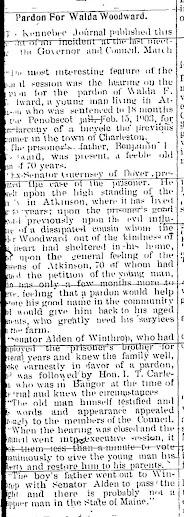
Walda Woodward received a pardon for his involement in the robberies, due to his father, Benjamin making a push through family connections.

Piscataquis Observer, March 10. 1904


After his pardon, Walda married his 1st cousin, Minnie Pearl Woodward.  They had three children born in Atkinson.  Walda left the area moving to Scarborough, Maine where he became a gardner and landscaper.  He died on 29 April 1932 in Scarborough, Maine.

Benjamin Woodward returned to farm in Atkinson and remained there until his family moved to Dover-Foxcroft.  Benjamin was considered the Moral Judge of the family and it is not known how this incident late in his life affected him.  This story was never discussed that I  can find by any descendant.  It was only by doing a general search in the local paper for Woodward and Woodard that was I able to uncover the entire crime story and who was involved.  I did not include entire articles as space it would not allow to put in every item.  I have referenced all the different sources I have used  to cover this period of time showing the various newpapers used to follow the story of the notorioius Woodward Boys Gang.

Sunday, September 26, 2021

Lucy (Perry) Southworth/ Southard: A Pauper's story

 When trying to sort the wives of my ancestor, Constant Southworth (the surname appears as Southard in later records, which the family adopted), I was surprised to see how his second wife became a pauper in the Town Records of Corinna, Maine.  I was also surprised to learn how towns dealt with their poor in the early 19th century before town farms were the common way for towns to maintain their poor, disabled, and metally challenged individuals.

Lucy Perry was born on December 28, 1760 in Sandwich, Massachusetts, the daughter of Zachariah and Hannah (Blish) Perry.   Her family eventually leaving Massachusetts and settling in Wayne, Maine before 1800.  Below is the family records from the Viatl Records of Sandwich, Massachusetts.


 In 1798, at the age of being considered for marriage and labeled a "spinster" Lucy Perry married Constant Southworth of " Conner" Maine.  He was actually of Corinna, Maine and had also been widowed by his first wife, Lucy Ford.  Constant Southworth had been born in Duxbury, Massachusetts on August 20, 1764 and had been a Revolutionary soldier who was granted land in Maine for his service in the War.  He had married his first wife in 1785 in Marshfield, Massachusetts and they had 7 children children.  

He had arrived in Fayette, Maine about 1786 where through records you see the surname change from Southworth in Massachusetts to Constant Southword on the 1790 census and Constant Southward on the 1800 census and then he appears in Corinna, Maine as Constant Southard.  He may have known the Perry family from his time living in the nearby towns of Fayette and later part of Readfield, Maine. 

A 1916 article on the town of Corinna's 100th  Anniversary, stated Constant was the first settler of the town in 1807.  His name is not on the petition for incorporation of the town, he was at the first Town meeting in 1817 where he was elected as a selectman, assessor and an overseer of the Poor.  From the begininng of the town of Corinna, there were people in need of assistance.  The town being incorporated in 1816, the year known as "The Year without a Summer."  1816 was a bad year world wide due to  the Volcanic eruption of Mount Tambora in Indonesia in 1815, which affected the climate and caused snow to fall in June of 1816 and destroyed crops for the year as the ground remained frozen most of the year.  If anyone was on the verge of poverty in 1815, 1816 would have pushed them over the edge.

It would appear that Constant and his family weathered through 1816, although, Constant did apply for a pension in 1818 "due to his reduced circumstances."   He died on November 26, 1826 in Corinna, Maine.  He was buried in a field behind his house.  


Constant’s widow, Lucy later also applied for a pension in 1835 which is included in the records with his application as follows.  It appears her pension application was rejected because of the issue with the spelling of the surname of Southard.

I do here certify that the foregoing pages number from one to four are truly copied from the originals on file in the Pension Office, War Department.

Henry S. Addison

And I do further certify that it appears from a List of final Settlement Certificates issued by John Pierce Esquire pay Master General and Commissioner of the Army Accounts of the United States deposited in said Office that Constant Southworth received three certificates for $17. 23 due January 1st 1783. for $80 due January 1st 1783. And for $57.50 due January 1st 1783 the name of Constant Southard does not appear thereon.

Henry S. Addison

Lucy B. Southard applied for land, on May 29, 1835 and her application was examined and rejected on July 17, 1835 stating her husband did not serve 3 years. Her Attorney was Robert C. Vose of Augusta. Lucy B. Southard, widow of Constant Southard, applied again for a land grant on March 24, 1836 with a new attorney, George W. Morton of Augusta. It does not appear she was successful with her second appeal. The last correspondence in the file is from her lawyer:

Augusta June 5, 1837

“Dear Sir,

I have received a package from you containing Abigail Roust, Wm Hardy, Martha True, Oliver Hartwell, Lydia Richardson, Mercy Holmes, Betsey Ewer, Lydia Pratt certificates under Resolve of Legislature of Maine of March 24, 1836. I believe in the application made by Lucy B. Southard for land under Resolve of March 17, 1835 which was rejected by reason of her husband’s service being less than three years, is a certificate of the Judge of Probate, was the cause of my not getting another rejected claim is presumed to be upon your files where the Judge’s certificates will be found. Should it not be found please inform me and I will furnish one immediately.

Yours with respect,

Geo. W. Morton

It does not appear that Lucy was successful  in her claim.  It is not known how much money she had from  received from her late husband's estate if any and if there was some other extenuating reason that may have caused Lucy to need the town of Corinna's asistance.  At this time, towns around New England to deal with paupers or individuals with any kind of disability or mental illness, would be set up at a public auction usually at the annual Town Meeting by the Overseer's of the Poor to be bid on by local townspeople to care for them at a certain rate of pay by the town.  These venues often meant splitting up families and being huniliated by being paraded out to be bid on by the people who had been your neighbors and friends.  Individuals who were young and could work to help around a farm or home would receive the lower bids because their could earn their keep or contribute to the farm or home.  Sadly, individuals who who could not contribute due to age, disability or mental stability would receive the highest bids to find a person to care for them.  In a case of a mental illness, a person would bid off with their cage included.  

Although, it is not known positively, Lucy (Perry) Southard did not have any children possibly due to her being almost 40 when she married, but Constant's youngest daughter, Lovina (Southard) Morse could have been from the second marriage to Lucy Perry.   This may explain why the Morse family often bid to care for her, even after the death of Lovina in 1826.  It could be that with Lovina being so young when her real mother died and her father remarrying when she was but a toddler, Lucy Perry was the only mother Lovina ever knew and the Morse's family may have felt a strong attachment to Lucy Southard.

Lucy (Perry) Southard begins to appear in the town records of Corinna in 1837 as a pauper to be bid off by the town for care.  Her husband had been one of the first overseers of the Poor for the town and now his widow would come under the overseer's care.  The first entry seems to confuse the wives of Constant Southard Sr. and Constant Jr. by calling her Widow Sarah Southard. The name of Lucy Southard is used in later records. Sarah (Hicks) Southard, wife of Constant Jr. was not a widow in 1837, but Lucy Southard had been a widow for almost 11 years by 1837.

Corinna, Maine Town Records:

March 5, 1837, town voted to pay Phillip Morse four shillings per weeks for keeping “Sarah” Southard for the past year. Voted to pay $25 to Phillip Morse to keep Widow Sarah Southard the ensuing year. The vote not accepted by Phillip Morse. Voted to give Phillip Morse four shillings per week to keep widow Sarah Southard the ensuing year and free from town expense.

March 19, 1838, town voted that Eben Boyden have seventy-five cents per week for keeping Mrs. Constant Southard for the ensuing year and to help her free from any expense to the town and is to take her into his home.

Philip Morse, who married Lovina Southard and who had agreed to care for Lucy in 1837 did not bid for her in 1838.  This could be explained by Philip's possible failing health as he died January 10, 1839.  The cause of death is not known, but if Philip was ill previos to his death for a period of time, the family may not have been able to care him and his former mother-in-law.  After Philip's death, his widow and 2nd wife, Mehitable Morse, who had no biological connection to Lucy, continued to care for her.  This could be because Lucy was the only grandmother the children would ever really know or Mehitable liked Lucy and did not want to see her auctioned off to strangers. 

August 26, 1839, town voted to authorize the selectman to agree with the widow Morse to support Lucy Southard from now until the next March meeting at a price not exceeding what she might be supported for on the town farm.

March 24, 1840, town voted to pay Phillip Morse’s widow twenty-five dollars to support widow Lucy Southard the ensuing years and the town to pay the said Lucy’s doctor’s bill.

March 12, 1841, town voted to Mrs. Morse twenty-five dollars to support Mrs. Southard the ensuing year.

This is the last available record at the State Archives, which end in 1843. It is assumed that Lucy continued to live her final days with with Morse family.  Lucy (Perry) Southard died September 15, 1848, Corinna, Maine.  She was buried with her husband in Corinna in the Constant Southworth Cemetery.  With the family's poor circumstances, no gravestone was erected for Lucy.

These are two closest stones to Constant's gravestone, and one would probably be his wife and the other probably mother who came to Corinna with him.


Sunday, August 8, 2021

How the Woodward Reunion Began

 When I was a kid it seemed normal to attend at least one family reunion in the summer.  There were two that I remember as a child and both on my mother's side of the family.  The Moulton-Thompson reunion and the Woodward Family Reunion.  Sadly it wasn't until the Woodward reunion ended that I learned how it began.

The Woodward reunion began from a family gathering in 1913 to celebrate the 50th wedding anniversary of my ancestors, Benjamin Jordan Woodward and Mary Emma  (Thurston) Woodward.  They were married on July 10, 1863 in Atkinson, Maine.

Benjamin and Mary Woodward


It was from this event that a reunion began and it continued for another 80 years.  Reunions were a serious events held annually.  Officers were elected, a meal was served, money was raised to cover costs for the following year either by asking for donations or asking for an items for the reunion auction where miscellanous items were bid on to raise money.  It was a once a year coming together of parents and children, siblings and cousins that you would not probably see otherwise unless it was a wedding or a funeral and usually it was the latter.  Although as a kid I usually hung with my immediate cousins I knew and older kids and youngers kids didn't usually mix unless it was playing baseball or horseshoes.  Everyone was expected to bring a dish which you would be assigned to on your reunion invite, a dessert, rolls, coffee or soda, or a salad or maybe a can of brown bread to go with the baked beans that were always the dinner staple.  There always seemed to be plenty of food and leftovers to be bid on at the auction.  Of course it was the women who worked in the kitchen cooking the food in the hot summer and doing the dishes afterwards and the men to play a game of horseshoes until the official reunion meeting began.

On September 10, 1913, the children and grandchildren and great-grandchildren of Benajmin and Emma Woodward as well as Benjamin's siblings and Emma's surving uncle who was in his 90s at the tiime, gathered at their home in Atkinson to give them a surprise party as the local newspaper recorded.

Those in attendance


1913

Front Row L to R: Thelma Bragg, Marion (Carr) Whitney, mother of Eva Woodward, Erwin Woodward, Rutillus Woodward holding Delma Cochran, Thornton Woodward, Delila Woodward, Clinton Woodward, Orman Pettigrew, (Eva Woodward's nephew)

Second Row L to R: Lillian Brooks Woodward, wife of Seth, holding Harland Woodward, John Woodman, uncle to Mary Emma Woodward, David Woodward, Lydia (Woodward) Gerry, Benjamin J. Woodward, Mary Emma (Thurston) Woodward, Jennie (Woodward) Hutchinson, Emma (Paine) Moulton holding Aubrey "Bob" Moulton

Third Row L to R: Seth Woodward, holding Ramson Woodward, Lela (Woodward) Cochran, Walda Woodward, Harriet (Hudson) Woodward, William Woodward holding Donald Woodward, William Bragg, Ethel (Woodward)  Bragg, Theodore Moores, Dorothy Bragg.

Fourth Row L to R: Irving Woodward, Edmond Woodward

Fifth Row L to R: Virginia Woodward, Geneva (Turner) Cochran, wife of Harry, Eva (Whitney) Woodward, Ella (Woodward) Reed, Minnie Woodward, Marion Woodward's mother, Frank Putnam and Eva Reed

Sixth Row L to R:  Harry Cochran, Marion Woodward, George Reed, husband of Eva Reed.


The Dinner Table
(my great-grandmother, Emma Moulton on the very right hold Bob)


My great-grandmother, Emma (Paine) Moulton attended the reunion with her youngest child, Aubrey Moulton.  As her husband and other children do not appear in the photos, I have to assume, she could not bring her whole family or maybe my great-grandfather did not want to attend.  He must have been back at the family farm with the other children, although, the family was also residing in Atkinson, Maine.  It may have been a situation where my great-grandmother was taken to the anniversary party by another relative who did not have enough room  on their horse and wagon for the entire Moulton clan.  A 5 generation photo was taken of her while there with her youngest child still nursing, she needed to bring her son.  Sadly her mother, Elsie (Woodward) Paine had died in 1891, so her aunt Lela filled in for her mother, just as Mary Emma (Thurston) Woodward's uncle, John Woodward filled in the generation foir her mother, Emily (Woodman) Thurston


 Five Generatons of Family
Left to Right

John Woodman (1818-1918) uncle to
Mary Emma (Thurston) Woodward (1848-1924) mother of
Lela (Woodward) Cochran (1873-1927) aunt to
Emma (Paine) Moulton (1888-1951) mother of
Aubrey "Bob" Moulton (1912-1989)


As time went on and the generations of descendants from Benjamin and Woodward grew, as with any reunion, eventually the cousins become more and distant in relationship.  Some family lines stopped attending due to distance to travel or lost interest as cousins who attended were now 4th or 5th cousins.  It seemed through the years, one family line would have more members attending and running the reunion.  The often resulted in fights, sometimes fueled with alcohol, feelings were hurt and rifts grew.  My cousin said when wasn't there a fight at the reunion between siblings, cousins, spouses who didn't get along or gossip about some relative that may or may not have been true, all lead to a decrease in attendance year after year.  Eventually the reunion decided to disband.

I'm sure my family's reunion was no different than other eeunions that have come and gone through the generations and years.  They would begin with a family gathering and deciding to make a more formal arrangement of gathering once a year.  The reunions you see continuing to day are more of people who have an interest their surname's family history or their connections to more famous people of history, like the Alden Kindred of America.   Where as our family reunion began with family members who had a desire to see each other at least once a year and not to reserve a family history, and ended when there was no interest in seeing the family of strangers only bound by a common ancestry.